The State of Out-of-Home Advertising in 2026
The latest global spending report from WOO (World Out of Home Organization) highlights a significant figure: global OOH closed 2025 at $54.2 billion, a 15% increase from the previous year. This marks the fifth consecutive year of growth for the medium, now accounting for 5.1% of total global advertising investment. However, the interesting aspect is not the total itself. It lies in how that total is composed and what still needs to grow in our region. The world is looking at more screens than ever, and LATAM is just beginning.
Digital Out-of-Home Advertising is (Almost) Half of the Pie
Within this global OOH, the digital segment has been steadily gaining ground. In 2025, DOOH accounted for 47% of total OOH spending, amounting to $25.5 billion. By 2026, WOO projects this share to rise to 49%, approximately $28 billion.
It is not yet the majority (static media still holds a slightly larger share for now), but the trend is clear: 2026 is the year when DOOH comes within inches of becoming, for the first time in the sector's history, the majority share of global OOH. The question is no longer if it will happen, but when.
Where LATAM Stands on This Map
This is where the report becomes truly interesting for the region. While in Asia-Pacific, DOOH already represents 55.7% of total OOH, and in Europe, 41.3%, in LATAM, that share is 27.7%. It is the lowest DOOH penetration in the world after Africa.
Viewed differently: LATAM is the region with the most room for conversion to digital media. What has already happened in other markets is still happening here. And that is not a weakness; it is the clearest opportunity the sector has in the region at this moment.
Brazil is already leading the way: it is among the ten largest OOH markets in the world, with $1.33 billion in OOH spend, and is one of the three economies with the highest growth in media share globally, along with China and South Korea.
Programmatic, Still in Its Early Stages, and There's the Window
Within DOOH, the programmatic portion (pDOOH) reached $2.1 billion globally in 2025: 8.4% of total DOOH. This figure confirms something important: programmatic is just getting started. There is still much ground to build, and whoever builds it first sets the rules.
There is an additional detail that says more than the number itself: WOO acknowledges that this pDOOH figure is not consistently captured in all markets, which is why it launched, along with PwC, a specifically audited study to measure programmatic with more rigor. You can see it here
It is basically the global industry admitting out loud a problem that Taggify identified some time ago: programmatic can scale quickly, but only if it can be measured with the same precision as a digital medium. Without standardization in measurement, each pDOOH campaign is an isolated case, difficult to compare, hard to defend to a client, and challenging to scale.
That's why we built Métrica: not as just another report at the end of the campaign, but as the foundation for every screen, in every LATAM market, to be measured with the same criteria.
The Summary
OOH is growing solidly and steadily. Within that growth, digital is the driving force and is on the verge of becoming the majority share of the medium globally. LATAM still has the longest path to travel towards this digitalization, which means it also has the greatest growth potential of any region.
And within that potential, programmatic is the newest frontier: still small, but with an urgent need for reliable measurement to scale.
More ideas for programmatic DOOH teams
Continue with practical reads on audience intelligence, inventory strategy and measurable real-world media.

The First Global Study on pDOOH Spending: Programmatic Outdoor is a USD 1.4 Billion Business
pDOOH generated USD 1.339 billion in 2025, representing 7% of total DOOH spending. Taggify participated in WOO's global study on programmatic outdoor advertising. The World Out of Home Organization (WOO) presented at its Annual Congress in London the first global study on programmatic outdoor advertising spending, independently conducted.
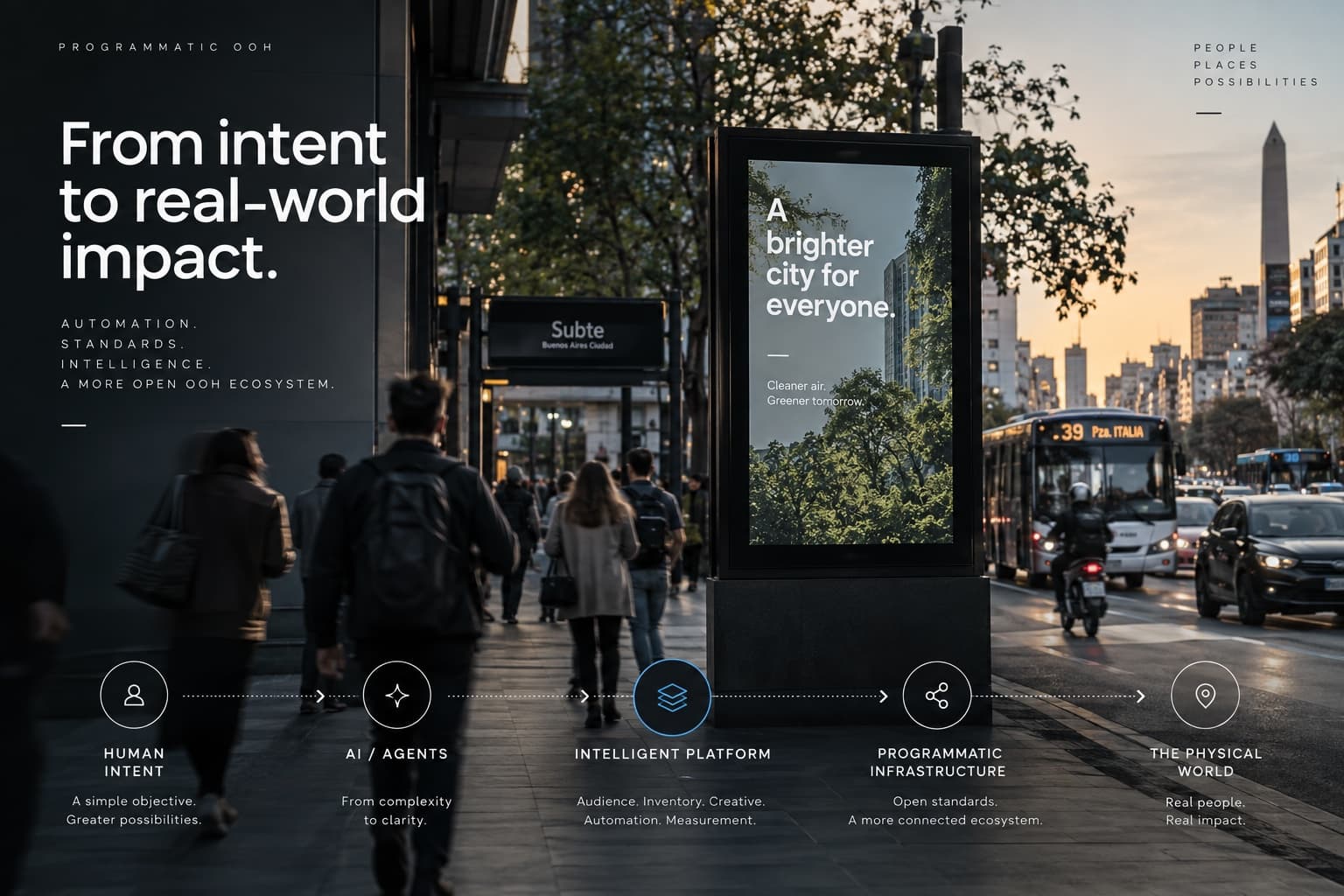
The Next Generation of Programmatic OOH Is Being Built Around Automation, Standards and AI
The Out of Home industry is evolving with a focus on simplifying the ecosystem through automation and standards.
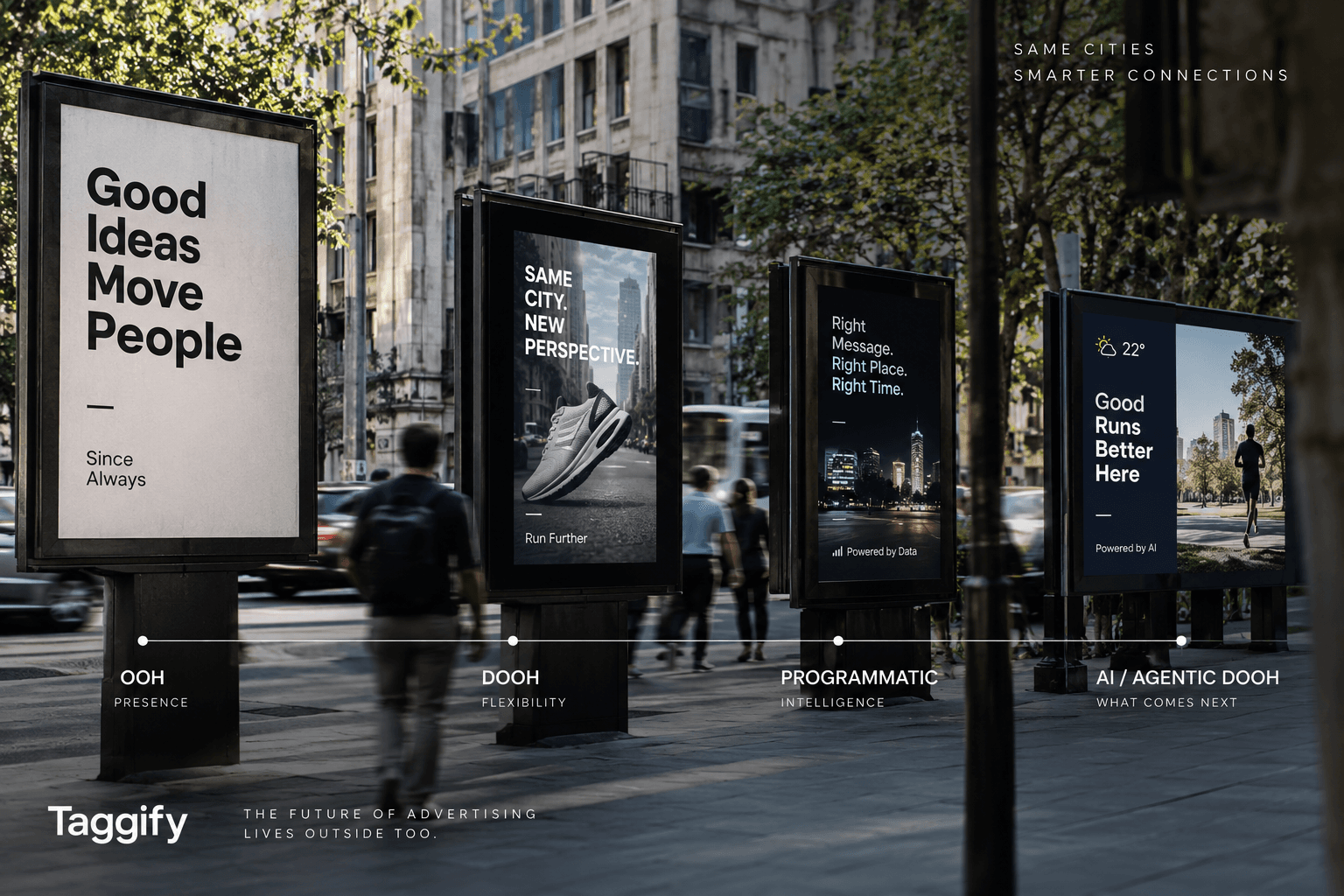
In the Attention Economy, Out of Home Has an Unfair Advantage
Out of Home advertising excels by capturing real-world attention, offering unique advantages in the fragmented media landscape.